8-14 Muscle tissue

SMOOTH MUSCLE – 5
How to differentiate connective tissue and smooth muscle tissue

Images of longitudinally sectioned bundles of smooth muscle tissue can be confused with images of dense connective tissue in hematoxylin and eosin-stained sections.
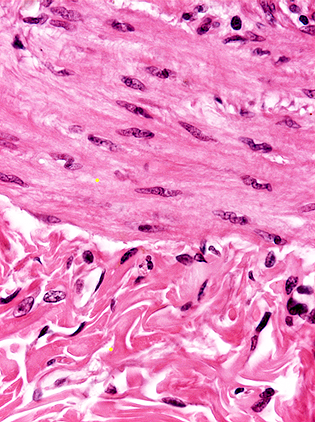
This page aims to help to distinguish connective tissue again (bottom image) and and smooth muscle (top image).

The nuclei seen in both images are sometimes similar. The main difference lies in the position of the cell nuclei in both tissues.
In the bottom image, observe tortuous fibers, some parallel to each other, others not. These are collagen fibers of connective tissue.
None of them have nuclei, as they are not cells, but fibers made up of molecules. The nuclei seen (highlighted in green) are external to these fibers. Theybelong to connective cells (mainly fibroblasts) or other cells present in the extracellular space. The cytoplasm of fibroblasts is and often cannot be seen.
The nuclei of muscle fibers have loose chromatin, are less stained, and are cigar-shaped. They are always located within the fibers. Fibroblast nuclei have dense or loose chromatin (dark or light) and their ends are usually tapered.

Smooth muscle. Staining: HE. Magnification: SMALL.

Dense connective tissue.Staining: HE. Magnification: medium.

END OF CHAPTER 8 MUSCLE TISSUE

PREVIOUS PAGE