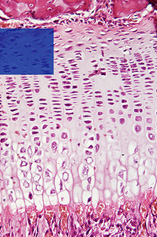
1 – The Zone of resting cartilage placed next to the bone of the epiphysis. The bone of the epyphisis (not highlighted) is the reddish band on top of resting cartilage. Its osteocytes are surrounded by a red/pink extracellular matrix.
The resting cartilage shows a typical appearance of a hyaline cartilage, formed by chondrocytes (highlighted in red) surrounded by a bluish extracellular matrix (highlighted in a dark tone of blue).
2 – Zone of serial cartilage. Chondrocytes highlighted in red and extracellular matriz in light blue. The chondrocytes divide actively by mitosis and become organized in vertical rows, like stacks of coins. The cartilage matrix is highlighted in a light tone of blue.
As a result of the chondrocyte`s division, their daughter cells accumulate at the end of this Zone. The continuous accumulation of new chondrocytes “pushes” the diaphysis away from the epiphysis, resulting in the longitudinal growth of the diaphysis.