NERVES – 2
Structure of the nerves
With the exception of the thinnest and most delicate nerves, there is generally an organization of their fascicles and of the connective tissue present in the nerve.
The nerves have an external sheath of connective tissue proper, of the dense irregular type.
This layer is called the epineurium (highlighted in pink after using the mouse or clicking on the image). In nerves of larger diameter, formed by many fascicles, the epineurium penetrates the interior of the nerve and surrounds each of the fascicles, as shown in the figure.
If the nerve runs inside a connective tissue or inside an organ, its epineurium may be less organized and blends with the surrounding connective tissue. In this case, the epineurium cannot always be well defined.
Surrounding each fascicle of nerve fibers is a layer called the perineurium (highlighted in blue). The perineurium is formed of elongated cells compactly arranged in layers. The nuclei of their cells are typically elongated.
Inside the fascicles there is small amount of loose connective tissue that surrounds each nerve fiber and contains blood capillaries. It is called the endoneurium (highlighted in red). It is usually present in such a small quantity that it may not always be observed in histological preparations. The endoneurium is a delicate structure and very often, due to the tissue processing to obtain the section, it undergoes retraction resulting in artificial spaces between groups of nerve fibers.
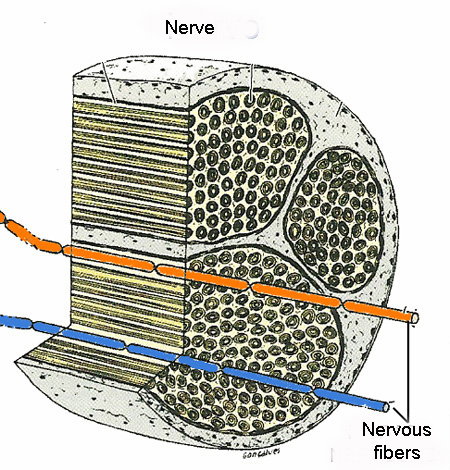
Drawing modified from “Basic Histology”, Junqueira and Carneiro, 12a Ed.
