SPINAL CORD – 2
The spinal cord is surrounded by three layers of meninges. During the dissection of organs of the central nervous system, the meninges often remain attached to the surfaces of the bones that surround them, such as the skull and vertebrae.
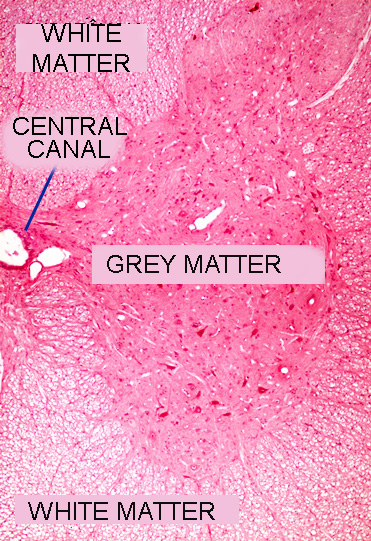
The gray matter of the spinal cord stains more intensely than the white matter because it contains numerous neuronal and glial cell bodies.
The central canal, also called the ependymal canal, is located in the center of the gray matter. In vivo, it contains cerebrospinal fluid (CSF).
The white matter consists mainly of nerve fibers, particularly axons, that run predominantly longitudinally along the length of the spinal cord.

Spinal cord. Staining: HE. Small magnification.

Spinal cord. Staining: HE. Small magnification.