ELASTIC CARTILAGE
The most important feature of an elastic cartilage is the composition of its extracellular matrix (ECM). It contains a large amount of elastic material, primarily in the form of elastic fibers, as well as varying amounts of type II collagen fibrils.
This peculiarity gives the ECM a great flexibility as compared to the other types of cartilages. It is found, for example, in the larynx, epiglottis, and external ear.
In hematoxylin and eosin-stained sections elastic cartilage may look very similar to hyaline cartilage.
Special stains (such as Verhoeff’s stain, Weigert’s stain) are used to identify elastic fibers in this type of cartilage.
This peculiarity gives the ECM a great flexibility as compared to the other types of cartilages. It is found, for example, in the larynx, epiglottis, and external ear.
In hematoxylin and eosin-stained sections elastic cartilage may look very similar to hyaline cartilage.
Special stains (such as Verhoeff’s stain, Weigert’s stain) are used to identify elastic fibers in this type of cartilage.
In both images, observe elastic fibers within the cartilage extracellular matrix as well as the chondrocytes (several highlighted in the upper image when you move the cursor over it).
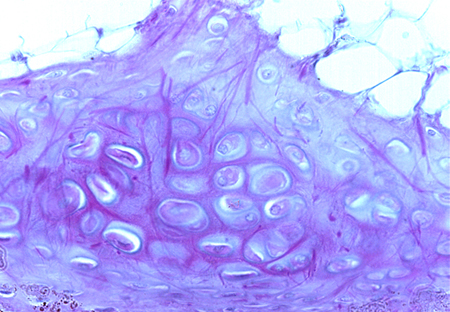
External ear. Staining: Weigert. Medium magnification.


Trachea. Staining: Weigert. High magnification.