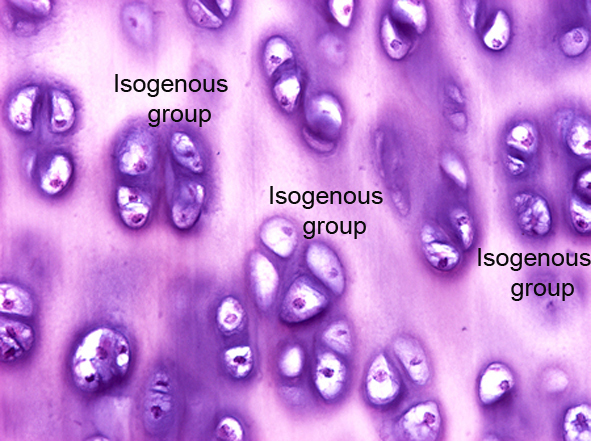
GROWTH OF CARTILAGE. ISOGENOUS GROUPS..
Sections of a mature hyaline cartilage show that most of its chondrocytes are not isolated. Very often they appear as agregates called isogenous groups. Each group is separated from neighbour groups by ECM.
The isogenous groups of chondrocytes result from one of the ways of growth of cartilage pieces called interstitial growth. Chondrocytes placed inside the cartilage divide by mitosis and due to the semi-rigid consistency of the extracellular matrix, their daughter cells tend to remain close. A few cycles of division of one chondrocyte result in the production of a small tri-dimensional cell aggregate, an isogenous group. Each one contains a clone of chondrocytes.
Another type of cartilage growth is called appositional growth. It happens by the addition new chondrocytes at the external surface of cartilage piece. New chondrocytes originate from the differentiation of mesenchymal cells present in the cartilage perichondrium.
Both types of growth may happen simultaneously in the same cartilage piece.
Three isogenic groups are indicated in the image.