CELLS ORGANIZE INTO TISSUES THAT BECOME ARRANGED IN ORGANS
The nervous system is composed almost exclusively of nervous tissue. It is nourished by the vascular system, that is formed by epithelial, connective and muscle tissue. However, with the exception of the nervous system, most organs and body structures are formed by a combination of several tissues. The organized combination of their tissues provides each organ with structural and functional properties that will allow them to adequately perform their activities.
The image shows a cross-section of the tongue surface. It is a good example of how several tissues (and others not present in this small sample of the tongue) combine to form an organ.
Each tissue performs its functions so that the organ as a whole can function properly: the covering epithelium protects the organ and has papillae that facilitate the mixing of food during chewing, contains taste buds that have a sensorial function. The connective tissue provides physical support to the epithelium, brings blood vessels to its cells and attaches the epithelium to the tongue muscles.
The muscles are responsible for the tongue movements. It is the predominant component of this organ although only a very small part of it appears in this figure).
The epithelium of the tongue glands secretes saliva into the oral cavity.
The nervous tissue (not present in the figure) receives impulses from the tongue’s touch and pressure sensors as well as from the taste buds. It controls the gland secretion and the muscular activity of the this organ.
All structures and organs of the body are built by a combination of tissues and arranged in characteristics ways.
The image shows a cross-section of the tongue surface. It is a good example of how several tissues (and others not present in this small sample of the tongue) combine to form an organ.
Each tissue performs its functions so that the organ as a whole can function properly: the covering epithelium protects the organ and has papillae that facilitate the mixing of food during chewing, contains taste buds that have a sensorial function. The connective tissue provides physical support to the epithelium, brings blood vessels to its cells and attaches the epithelium to the tongue muscles.
The muscles are responsible for the tongue movements. It is the predominant component of this organ although only a very small part of it appears in this figure).
The epithelium of the tongue glands secretes saliva into the oral cavity.
The nervous tissue (not present in the figure) receives impulses from the tongue’s touch and pressure sensors as well as from the taste buds. It controls the gland secretion and the muscular activity of the this organ.
All structures and organs of the body are built by a combination of tissues and arranged in characteristics ways.
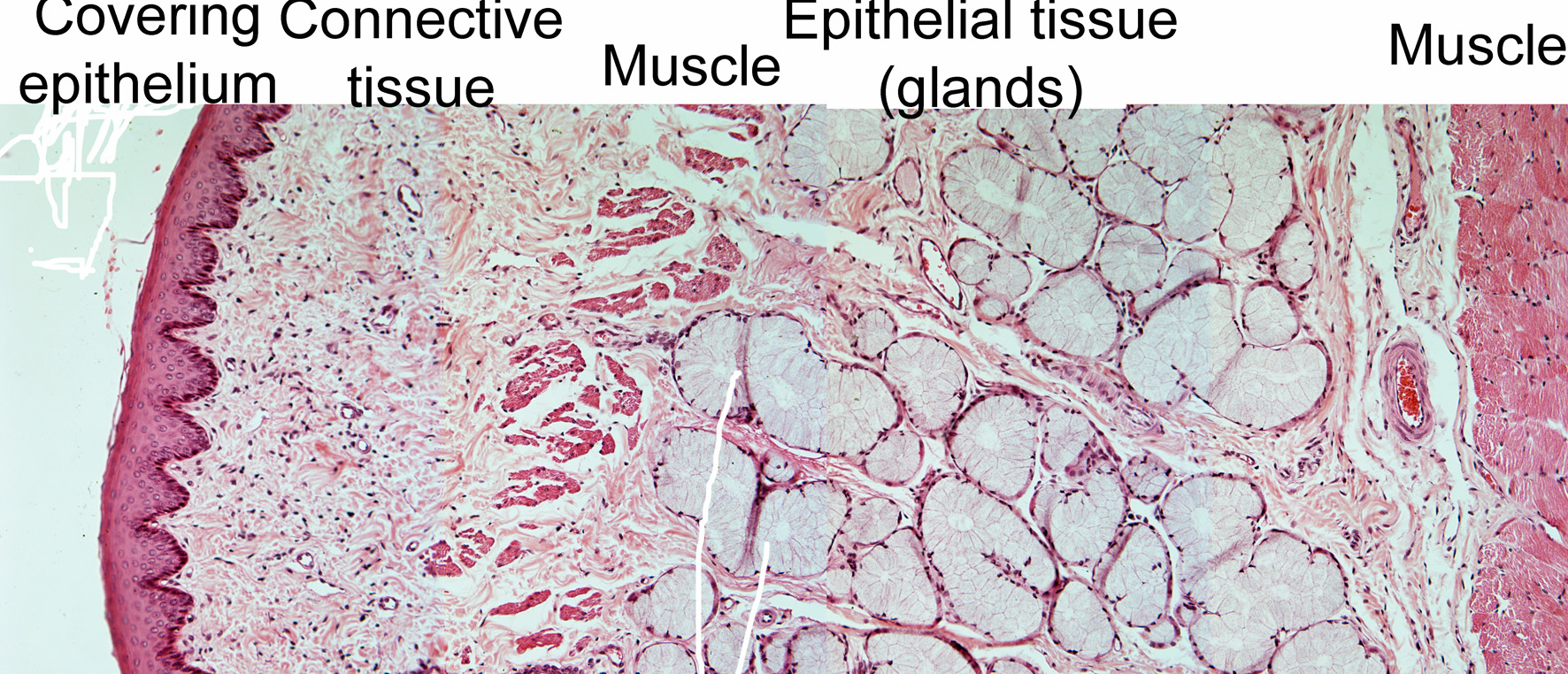
Tongue. Staining: HE. Small magnification
END OF CHAPTER 1